
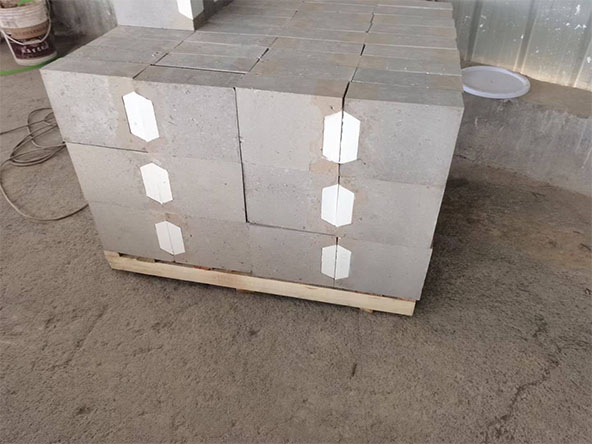
Product Introduction
Phosphate bricks are chemically bonded refractory bricks with low sintering temperature. They are formed after being trapped for more than 16 hours and sintered at a low temperature of 600℃. Some impurities can be fully volatilized during the trapping process. In addition, the unique particle size distribution and the role of the binder make its performance more stable.
Product Advantage
- Phosphate bricks have good chemical stability, low thermal conductivity
- Excellent wear resistance, good corrosion resistance
- Can resist the corrosion of acid, alkalinity and molten metal.
Application Field
The phosphate bricks are mainly used for the lining of blast furnaces, converters, electric furnaces and other equipment lining. They can effectively protect the lining from high temperature and molten metal corrosion, and improve the service life of the equipment and steel production efficiency.
Product Data
| Items\ Name | Phosphate Brick | High load soft bricks and composite bricks | Phosphate bonded high temperature and high strength wear resistant bricks | ||
| P | PA | GH-80Working lining | Composite brick | HAS | |
| Al2O3 % ≧ | 75 | 77 | 80 | 40 | 80 |
| Fe2O3 % ≤ | 3.2 | 3.2 | 2.0 | – | 1.8 |
| CaO % ≤ | 0.6 | 0.6 | – | – | – |
| Bulkd ensity g/cm3 ≥ | 2.65 | 2.70 | 2.90 | ≤1.9 | 2.95 |
| Refractoriness ℃ ≥ | 1780 | 1780 | 1790 | 1650 | 1790 |
| Cold crushing strength MPa ≥ | 60 | 65 | 60 | 20 | 80 |
| 0.2MPa Refractoriness under load ℃ ≥ | 1300 | 1250 | 1460 | 1200 | 1550 |
| Thermal conductivity(1000 ℃) W/m.K≤ | 1.5 | 1.6 | 1.6 | 0.75 | 1.6 |
Related Products
The phosphate bricks have been made into composite refractory bricks, one brick is divided into two areas, light and heavy parts. The heavy parts are used for the working layer and the light parts are used for the insulation layer. This can play a role in insulation and slow heat dissipation, saving fuel costs while maintaining the low temperature of the outer kiln skin. The products are mostly used in lime kilns, zinc smelting kilns, and cement rotary kilns.