
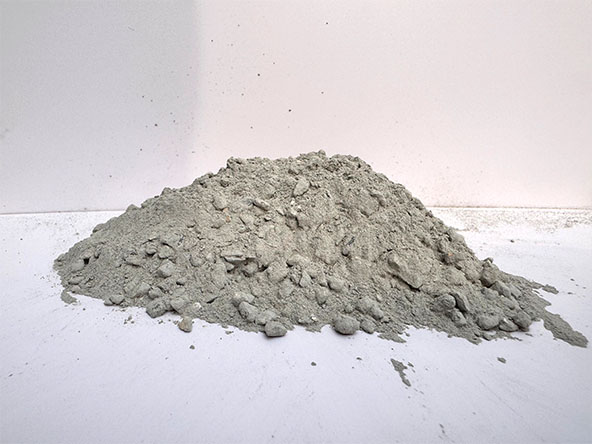
Product Introduction
Anti-seepage dry barrier is mainly composed of bauxite clinker aggregate, powder, binder and admixture with particle grading, and is constructed by manual and mechanical ramming. It can react with electrolyte at high temperature to form a dense glaze to prevent electrolyte and aluminum solution from continuing to seep down.
Product Advantage
Low thermal conductivity and strong anti-penetration
Anti-seepage dry barrier has the characteristics of low thermal conductivity and strong anti-penetration. It is laid at the bottom of the aluminum electrolytic cell and forms a layer of nepheline at high temperature to prevent Na+ And NaF vapor and aluminum liquid from penetrating and corroding downward.
Significant energy saving effect
The performance of anti-seepage dry barrier is low thermal conductivity and significant energy saving effect. It effectively inhibits and slows down the damage of electrolyte and vapor infiltrated during aluminum electrolysis to the lower insulation layer of the electrolytic cell.
Extend the service life of the electrolytic cell
In addition, anti-seepage dry barrier can also prevent the penetration of the aluminum liquid and electrolyte. It can extend the service life of the electrolytic cell and prevent the electrolyte from entering the refractory insulation layer, increasing its thermal conductivity and increasing the power consumption of the electrolytic cell.
Product Data
| Brand \Product | High strength anti-seepage barrier | Dry barrier | |||
| PTJ-1 | PTJ-2 | PTJ-3 | PGF | ||
| Chemical (Al2O3+SiO2) ≧ | 90 | 90 | 90 | Al2O3 <40SiO2>60Fe2O3<3 | |
| Bulk denstiy g/cm3 | 2.7 | 2.4 | 2.2 | 1.8-2.0 | |
| Modulus of rupture/Cold crushing strength Mpa | 110℃×24h | 8/50 | 5.5/30 | 5/30 | / |
| 1000℃×3h | 12/80 | 12/65 | 10/60 | / | |
| Reheat linear change 1000℃×3h % | ±0.3 | ±0.3 | ±0.4 | / | |
| Thermal conductivity(350±25℃)W/m.k | 0.85 | 0.6 | 0.55 | 0.5 | |
Application Field
Anti-seepage dry barrier are mainly used in aluminum electrolytic cells to prevent the intrusion and corrosion of molten aluminum.